
Exam Strategy
Grade 11 Term 3 Control Test Prep With Practice Questions
A Term 3 control test has a narrower syllabus than a full exam, but it usually arrives with less warning and no second chance to make up the mark elsewhere. That combination, less to study but less time to study it in, is exactly the situation the practice questions were built for. Here's what a Term 3 control test usually covers, and a step-by-step way to actually use the practice questions in the weeks before one.
By The Determine This Team · 8 September 2026 · Grade 10–12 · CAPS · NSC Mathematics
Most students revise for a control test the same way they'd revise for anything: reread the topic guide, redo a few old homework questions, hope it's enough. That approach works reasonably well for a full exam, where there's time to be broad. It works less well for a control test, where the syllabus is narrow enough that you could realistically drill every question type it covers, if you spent your limited time on the right thing instead of the comfortable thing.
What a Term 3 Control Test Usually Covers
Term 3 for Grade 11 is built around two topics: trigonometry (the sine rule, cosine rule and area rule, applied to triangles that aren't right-angled) and statistics (measures of central tendency and dispersion, skewness, and the ogive). A control test in this window will usually draw from one or both, since that's what's actually been taught by test week. For the full breakdown of what CAPS requires in each, which rule to reach for and why the ogive is a reading skill rather than a calculation, see this site's dedicated Grade 11 Term 3 guide to trigonometry and statistics. This article picks up where that one leaves off: once you know what to study, how do you actually drill it efficiently in the days you have left?
Why a Narrow Syllabus Is an Advantage, Not Just a Relief
A control test's smaller scope means comprehensive coverage is actually achievable. You can't realistically drill every question type across an entire year's syllabus before a final exam, there's too much of it. You can drill every question type in trigonometry and statistics before a control test, if you use the time on targeted repetition instead of rereading notes. That's the entire logic behind using the practice questions specifically for control test prep rather than general revision: the smaller the syllabus, the more a focused tool outperforms a broad one.
The Four Steps of One Practice Question
Each question in the practice section follows the same shape, and it's worth understanding why before you start, because the value is in step three, not step one.
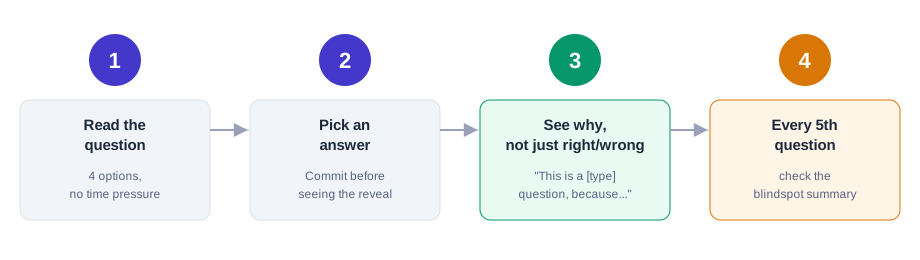
Step three is where most other practice tools stop short. Getting told you're wrong doesn't teach you to recognise that question type next time it's worded differently. Getting told "this is a cosine rule question, you can tell because you're given all three sides and asked for an angle" does, because it names the exact signal you missed or used correctly. Read that sentence every time, even when you get the answer right, especially when you get it right by a method you're not fully sure of.
What to Do With the Blindspot Report the Week Before
After every five questions, the practice section shows a short summary: accuracy by question type, and which types you're consistently getting wrong. There's a separate blindspots page that tracks this across every attempt on your device, not just one session, so it gets more accurate the more you practise in the days leading up to a test.
The week before a control test, this report is more useful than a fresh set of questions. It turns a vague feeling of "I'm not confident on trig" into a specific list, for example, area rule questions are fine, but cosine rule questions where you're given all three sides keep tripping you up. That specific list is what you drill in your remaining study time, using the mini exercises linked from each topic guide, rather than spreading your last few days evenly across everything.
Each Blindspot Links Straight to a Mini Exercise
The blindspots page doesn't just name a weak question type, each one links directly into a filtered set of questions for that exact type within its topic, so you're not scrolling through a full topic's question bank hunting for the ones you actually need. A blindspot only shows up after at least three attempts at that question type and an accuracy below 60%, so it's not flagging a single unlucky guess, it's flagging a pattern.
That threshold matters for how you should read the report early in the week versus late in it. Early on, with only a handful of questions answered, don't take the list too literally, three shaky attempts at cosine rule questions might just mean you hadn't seen enough of them yet. By the third or fourth day, once you've built up a real spread of attempts across both topics, the list is worth taking seriously and drilling directly.
A Simple Way to Split Your Remaining Days
If you've got roughly a week, a pattern that works better than reading notes cover to cover: spend the first two or three days doing a normal spread of questions across both Term 3 topics, just to get the blindspot report populated with real data. Spend the middle days drilling specifically the question types the report flags, using the topic guide's method skeleton for any type where you're not just making careless errors but genuinely unsure of the steps. Spend the final day or two on a fast, mixed set across everything, to check the fix actually held under less predictable ordering, since a real test won't group all the cosine rule questions together for you.
What This Won't Do For You
The practice questions test whether you can recognise a question type and reach for the right method, they don't replace learning that method in the first place. If a topic guide's method skeleton for, say, the cosine rule still doesn't make sense after reading it, that's a content gap, not a recognition gap, and no amount of multiple choice repetition fixes it. Go back to the topic guide itself, or a full worked-solution resource, before returning to practice. The two are meant to work together: content learning first, then recognition drilling once the method itself is solid.
Start with today's daily question, then work through the instruction word guides and topic guides.